Showing posts with label Low Coutry Life. Show all posts

Friday, April 4, 2008

Shrimp Boats at the Bailey Docks

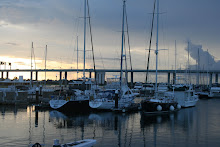
Recently the town of Mt. Pleasant, South Carolina closed the Bailey Docks on Shem Creek because of safety concerns. To many this comes as no surprise as the docks have been in disrepair for a number of years.

Still it reminds us that our seafood industry has fallen on hard times, due mainly to imported farm raised shrimp and soaring fuel prices. But it’s more than a few boats being forced off the docks; it’s a way of life and part of our South Carolina heritage that is being erased.

Years ago the "fleet" at Shem Creek might have been nearly two dozen strong. A forest of outriggers reaching skyward; nets hanging in the humid summer coastal air, boats docked sometimes three abreast at Shem Creek.

Photobucket

Shem Creek Circa 1976 Photo by Don Burbidge

The summer sounds of shrimp boats unloading the day’s catch dockside, men at work on boats often mixed with dishes clanking together and joyous conversation at seafood restaurants less than 20 feet away.

Shem Creek was the center of the seafood business in Charleston for the longest time and a natural location for seafood restaurants, many of which are now also gone.

Photobucket

Across the Carolinas, shrimp boats have plied the coastal waters since the early 1900's. Port Royal was once home to one of the largest shrimp processors in the state. Beaufort was once home to several builders of shrimp boats. But since 2000 the number of active shrimp boats in the state has declined by 50% and this year the number of boats is expected to fall by half again.

On Seabrook Island back in the 80’s my brothers and I would rise before day break and count the shrimp boats, that passed by less than 100 yards from shore. The sound of diesel engines would fill the air, bright deck lights illuminated the boats like it was mid day as we watched the deck crews going about their chores, our shore side voyeurism unnoticed. Each boat would slowly pass and then disappear into the faint light of a summer’s dawn.

The Rockville Fleet would be joined by boats from Edisto and Beaufort, Folly and Mt. Pleasant and further up the coast, Georgetown and Murrells Inlet. The lights of shrimp trawlers would greet the day and pace back and forth hour after hour, while beach goers enjoyed a lazy day in the surf.

Offshore the shrimp boats were always a beautiful sight, spotless white hulls and brightly colored pilot houses of red and green and blue, with names like Miss Liberty, Tina Marie, Jennifer Ann and Lady Eleanor. Like girl friends from the past, at a distance beautiful, but often rusty, faded and of poor repair up close.

They are work boats, and the men aboard these boats take pride in what makes a shrimp boat sea worthy, a sturdy deck and a solid keel with plenty of diesel power to keep going straight under the strain of her nets in the water.

Photobucket

A plastic snow globe from Myrtle Beach features a shrimp boat on a blue plastic ocean. When shook tiny seagulls circle around the trawler like wild snow flakes and then descend to back to rest on the bottom, only to be shook again and again, a tacky plastic souvenir from our cultural past and our heritage that is now being lost.

If you close your eyes you and still hear the sounds of seagulls, as they compete for scraps sent overboard, the rumble of diesel engines hard at work going out for another day of casting nets, sounds that once echoed throughout the low country early each summer morning not so long ago.

Monday, February 18, 2008

Breakfast

A cool rain has come to Charleston this morning. The forecast that was calling for strong winds and thunderstorms has been down graded to a steady rain, perhaps the first of many spring showers to come.

Now in early morning darkness Charleston has slowly begun to waken, and traffic is still sparse for today is Presidents day. Banks are closed as is the Post Office and many government offices but everything else is up and running including the sprinklers at the Coastal Carolina Savings Bank despite the steady rain.

I’ve always found sprinklers running in the rain one of mankind’s oddest achievements, like stoplights that show red for a painfully long time without another car in sight.

Long before sprinkler systems and traffic lights a plenty, a day of steady Low Country rain was a day off from work in the fields. Rainy days meant a time to catch up on some tractor maintenance or pull that starter off the pickup and fix the front door that has been sticking since fall.

A Monday rain was even better since week long projects had yet to be started and some things could wait. Years ago breakfast on a farm was an amazing adventure and many times I witnessed this daily occurrence that was normal to my farm raised cousins.

By 5:30 a half a dozen pick-up trucks were parked in the yard of the main farm house. As headlights illuminated the down pour, rain coats dashed up the gravel drive and were left in a red and yellow pile of dripping wetness just outside the side door that was well lit by a single light under the covered porch.

As best I could tell half of the young men who dripped their way into the large farm house kitchen were true family the other half adopted, but each gave my great aunt a quick good morning kiss on the cheek before sitting down to breakfast while outside the steady rain continued.

Of course this event happened on sunny mornings as well since tradition held that my great aunt fixed breakfast at the Coleman Farm every morning. Sons who lived down the road and next door came as did the hired help; all were treated like family, so for me it was sometimes hard to tell who was who.

Sausage, grits, scrambled eggs, coffee, biscuits and toast made the rounds. As a chair was pushed back and an empty plate removed, someone else would quickly fill the void. Most who departed did so with coffee in hand and a warm biscuit wrapped in a paper napkin in the pocket, which went a long way to make working in the rain nearly enjoyable.

One by one or in pairs they left heading out the door after a quick hug from my great aunt, into the pre dawn darkness. The sounds of bacon frying subsided and rain came harder as the last of the pickup lights twisted around the drive and down the road, at just after six in the morning, signaling the end to one of mankind’s greatest invention, breakfast.